Sunday, November 27, 2011

Normandy High School Yearbook 1945


"ALLAN BORGMAN...lent tuneful clarinetic notes to the Senior Band, Norsemen and Orchestra...struck a scientific chord in Chem Club...set many Courier readers on the beam with informative "short wave" stories."

Wednesday, November 23, 2011

Proud father with his daughter Carole.

Tuesday, July 19, 2011

Other Materials in the Archives

Autographed photo of Glen Gray.
The George A. Borgman Archive (GABA) doesn't just contain books, recordings and Borgman's writings and photographs, it also conatins a modest collection of jazz memorabilia which includes autographed photographs, letters and various signatures of jazz and big band figures.

Some of the autographed photographs include signed photos by Thomas "Fats" Waller's guitarist Al Casey, Louie Bellson, Max Roach and one of drummer Jack Carter from 1937.

Other materials include letters written and signed by Lionel Hampton and Paul Whiteman as well as autographs of Bob Crosby, the Mills Brothers, and Woody Herman. There are also some signed albums of various artsist new and old.

These are just some of the other interesting items held in the Archives.

Sunday, July 10, 2011

"Interesting Experiences as a Special Agent with Military Intelligence" by George A. Borgman

"I had many interesting experiences in the Army in the United States and overseas. I have been involved in various counterespionage activities and investigations in Washington, Germany and Vietnam, plus anti-terrorist activities in Germany.


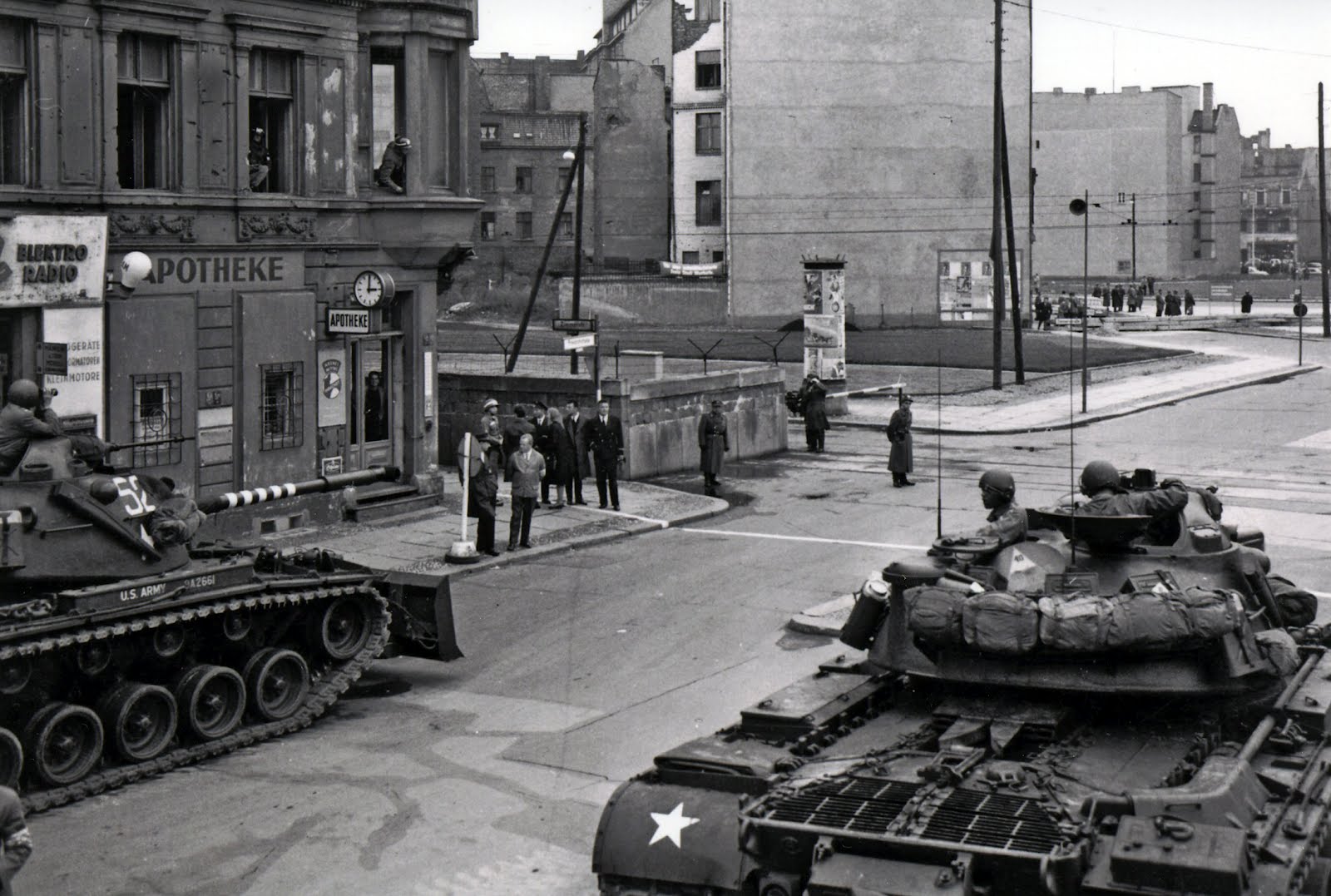
As a MI Special Agent, US Army, I was in West Berlin when the Wall went up in August 1961 and was in the Pentagon during the last days of the Cuban missile crisis in November 1962.

In October 1967, I worked undercover as a middle-aged hippy during the Pentagon anti-war demonstration and took part in Army coverage of the burning of Washington, D.C., after the assassination of Martin Luther King in April 1968.

I supplimented Secret Service during President Richard M. Nixon's first inauguration in January 1969. Then I spent one year in Vietnam. I was in charge of MI special agents who supplimented the Secret Service during President Jimmy Carter's visit to the Federal Republic of Germany in 1978.

I retired from the U.S.Army, after 23 years total service, as a Chief Warrant Officer 3. I've had an interesting life and have enjoyed it."

Saturday, July 9, 2011

Milton Irving Orchestra

"I played tenor sax and clarinet in Milt Irving's Orchestra at the Catholic USO in St. Louis in 1944. Donald Stolz, who played trumpet in the St. Louis Symphony, was in the band. Later, we were classmates at the St. Louis Institute of Music in Clayton, Missouri."

Irving A. Kurth and a man named Milton formed a small band called the Milton Irving Orchestra in 1944. They played for the entertainment of army personnel through the USO in the St. Louis area.

Kurth was born in 1905 and married a woman by the name of Adelaide and they had one son Robert. It is not known when Irving died but his wife passed away, presumably after he did in August of 1979.

George joined the band in September of 1944 and stayed with them until the orchestra folded in around June of 1945.

There is evidence that the orchestra may have reformed as there was a band by this name in Missouri  in operation as late as September 1948 and may have continued several more years after that date.

Tuesday, June 7, 2011

George's grandfather John A. Borgman

George A. Borgman’s grandfather was John Allen Borgman. George visited him in Jonesboro, Arkansas when young. He remembered him as a gregarious fellow who liked to talk to people. Late in life George could still describe the Borgman homestead in Jonesboro.

John was born in Attica, Indiana and was the son of Francis John Borgman and Frances Jane Beauchamp. He was a twin. His brother who was born first, was George M. George died of illness at the age of eighteen.

His father Frank served in the Union Army during the American Civil War, having served in two regiments one in West Virginia the other in Indiana. According to George’s father Herman, Frank was an aide to General Sherman but he did not continue on the Atlanta campaign because he was called away on other duties.

John and his father moved out to Arkansas while endeavoring in the lumber trade. John eventually moved to Jonesboro in 1906. He married a woman from Tennessee, Mary Owen Harris, the daughter of Thomas H. Harris, a Confederate veteran. They had two children Herman Francis and Lola. His wife Mary came down with tuberculosis as did Lola. His wife died of the illness, and a year later he married her younger sister Ida Harris.

His son Herman, for whom Herman, Arkansas is named after, related a story published by The Jonesboro Sun in its Off The Beaten Path column. "The Frisco used to have a water tank at the north end of the trestle across Big Bayou. They pumped their water out of the bayou. The tank fell down across the track and my father... flagged down the northbound fast train (106) and prevented it running into the tank on the track."

John was very active in politics, and it was his being a Republican which led to his appointment as postmaster. Borgman was appointed acting postmaster from July 1, 1922 replacing postmaster Charles B. Gregg and served as postmaster from February 14, 1923 to July 1, 1933. He served under three presidents Harding, Coolidge, and Hoover. He was a Republican delegate at the Arkansas Republican State Convention in Little Rock on May 3, 1928 and a delegate at the Republican National Convention in Chicago on June 14, 1932.

It was also said that John served as a U. S. Marshal for a time, but records regarding this have not yet been searched for. His only surviving child Herman Borgman became an employee of the St. Louis Post Office in 1920.

George was not yet five when his grandfather died at the age of seventy at 2:20 PM on January 15, 1937 at his home in Bay, Arkansas. His funeral was held on January 16 at the Gregg Funeral Home and he was buried in Oaklawn Cemetery.

Monday, June 6, 2011

From Disciples of Christ to Roman Catholic

As early as 1992 George started the wheels turning on his conversion to the Roman Catholic faith. Here he writes about his conversion to Roman Catholicism from the Disciples of Christ on May 4, 1993.


Father Murray's St. Denis Church
“For some time now, I have wanted to become a Roman Catholic. First of all, Janet has had nothing to do with it. After all, she did marry me, a divorced man, in Kingshighway Christian Church in St Louis. She has never encouraged me to become a Catholic. It’s strictly my own decision.

One reason is that there were Catholics on both sides of my family until about two generations ago. Another is, as long ago as 1951 or 1952, when I took a course in European History at St. Louis University, I was thinking about converting, because the professor gave a completely objective picture of Martin Luther and the Reformation.

I have always been against abortion and euthanasia, and the Catholic Church is actively opposing both of those horrible activities.

Also, since covering high school sports here, I met a prince of a man, a Catholic priest, Father Fred Murray, who is a retired Navy chaplain. We ran into one another at games and took a liking to one another, because we both were retired military. He is a parish priest of a church in Westwood.

Father Murray, who resembles Spencer Tracey, made no effort at all to recruit me, believe me, and, in fact, I approached him at a hockey game about converting. He almost went into a state of shock, because there aren’t any conversions to anything nowadays! So I began instructions with him.

I submitted paperwork, and Janet and I had to go for an interview at the Metropolitan Tribunal of the Archdiocese of Boston, and we were told that my first marriage can be set aside by the Pope, because Ann was not baptized a Christian, and Janet and I can renew our marriage vows.”

On February 28, 1996 George was taken into the Catholic Church and he and Janet renewed their marriage vows.

Monday, May 30, 2011

"Barney Google"

Here is a novelty tune treat! "Barney Google," written by Billy Rose and Con Conrad.
Sheet music for the song.
This was one of George's favorite tunes as a child. He would listen to it on his Aunt Ruth's Edison phonograph. Years later when he inherited the beloved Edison phonograph, "Barney Google" was not among the Edison records.

This tune below, is believed to be the very same version that George played with delight in the 1930s. It was recorded on April 13, 1923, and features the vocals of Billy Jones and Ernie Hare.

Little did he know that the date of April 13th, when this was recorded, would be the birthday of his future wife, Janet Ferroli, who also had fun listening to this song!

So, without further ado...Enjoy.


Tuesday, May 10, 2011

Books, Books, Books

As a jazz writer, researcher, reviewer and reporter George was prolific. Especially since he got started in his jazz writing later in life, he has scores of articles, reviews, liner notes, photographs, interviews and research for various book projects.

At this time we are assessing all his writings and evaluating which book projects would be best to start with. As early as the 1960s George was researching one of his favorite performers Jack Teagarden for whom he met, played with and shared a bottle back in the day. Considering he died in 1964, George basically researched his whole life even writing to request his birth certificate from Texas, to which he received a response that no birth record existed for him in their records.

George published an article concerning his first meeting with Big T and is barely in frame in a great photograph he had in remembrance of the night he played with T. Perhaps his biography on Jack Teagarden might be a good beginning for a George A. Borgman book launch.

Friday, May 6, 2011

"What is Traditional Jazz?" by George A. Borgman

What is traditional jazz? It is the wonderful music that originated in New Orleans, traveled on river boats up the Mississippi River into Memphis, St. Louis, and eventually into Chicago and New York City. In Chicago such black musicians as Louis Armstrong and King Oliver were featured in clubs, and several white musicians from New Orleans formed the Original Dixieland Jazz Band there and moved on to New York, where they made the first jazz recording. The stride piano style allegedly originated in New York's Harlem.

During Prohibition, jazz became so popular in speakeasies and night clubs that the 1920s became known as the Jazz Age, and music performed for the dancers is known as hot dance music. It was played from charts, and solos were improvised, whereas the music of New Orleans and Chicago was performed without music. As time went by, along came such bands as Fletcher Henderson's and Glen Gray's Casa Loma Orchestra, and they began playing a more jump style that led into the swing idiom.

Johann Sebastian Bach
All the styles mentioned above can be called traditional jazz, in my opinion. Many people imply that jazz is the only music that is improvised. That's not true, Johann Sebastian Bach and other organists improvised in cathedrals, and in my opinion any composer - a monk who thought up a Gregorian chant, Bach, Mozart, Beethoven, George Gershwin and other Tin Pan Alley composers - were improvisers when they wrote original tunes. So, improvisation is not limited to jazz, trad or otherwise.

I was classically trained on piano, clarinet and saxophone and have two degrees in musicology, but I love jazz and swing, which I used to play in the 1940s and early 1950s. I was never a great improviser, though, and I admire the jazz musicians who can improvise well.

I have one pet peeve, and that is when a bandleader identifies the music of "Louisiana Fairy Tale" as being written by Fats Waller or Louis Armstrong! J. Fred Coots wrote the music for that tune. Let's get it right, guys! And who was the clarinet player who took the solo on "Louisiana Fairy Tale" on the original This Old House on PBS? The answer: Billy Novick of the New Black Eagle Jazz Band.

Thursday, May 5, 2011

Jazz Journalists Association Won't Post George's Obituary

Without any response to inquires, as to why George A. Borgman who had been a jazz journalist from 1991 to 2009, the Jazz Journalists Association, for whom George was a member, has refused to acknowledge George’s death and post his obituary on the Associations website jazzhouse.org under The Last Post.

An obituary was sent via e-mail to Todd Jenkins on November 7, 2009 after asking Mr. Jenkins whether they would be interested in posting it. Noticing that no obituary was posted on The Last Post Mr. Jenkins was contacted again on November 20, 2009. He wrote back saying, “I've been having a lot of browser problems; I can't get anything to upload properly. If I can't get it resolved over the weekend, I will e-mail this file to another JJA contributor and have him upload it. Sorry for the delay!”

Fast forward to April 26, 2011 when it was again noticed that no obituary, not even a short mention, was listed on the website. Mr. Todd was contacted, again, via the website’s contact page, with this message, “I had submitted an obit on JJA mem. George Borgman who died in 09. He wrote for several trad jazz pub + was a contributing editor and NE correspondent for The Miss Rag. I noticed he was not added. Why?”

This time there was no answer.

What explanation could there be for not publishing Jazz Journalists member George’s obituary? Is this just some ham-fisted oversight or is there another reason why the Association won’t acknowledge his death?

Monday, April 25, 2011

George Remember's The Jack Staulcup Orchestra

Here is a little band bio George jotted down on October 22, 2005.
Jack Staulcup 1980
"The Jack Staulcup Orchestra was a Midwestern territory band that operated out of Paducah, KY. Staulcup was a resident of Metropolis, IL. In 1950, the band members, traveling in a school bus, with seats that didn't recline, played many one-nighters, with the musicians sleeping overnight on the bus. At one point, the band played thirty one-nighters in a row. In Summer 1950, the band recorded for Oriole Records in Chicago. The session took place at a radio station in a skyscraper in the Loop."

Some of the tunes that were recorded during this session were, Red Lips Kiss My Blues Away, The Wooden Soldier and the China Doll, Here Comes My Ball and Chain and Baby Won’t You Please Come Home. George was one of the saxophonists during these sessions.
Here is an earlier version of the tune Red Lips played by The Kit Cat Band
 recorded in London on  June 3, 1927.

Monday, March 7, 2011

"Stan McDonald, Playing It With Passion" by George A. Borgman

In the February 2003 issue, of the noted jazz publication, The Mississippi Rag, George's article on longtime friend and traditional jazz extraordinaire Stan McDonald was published. Here is a link to the article Stan McDonald, Playing It With Passion.

Recently, Stan McDonald was the focus of a series of interviews by Dave Radlauer on his award winning radio program Jazz Rhythm.

Thursday, January 20, 2011

Westwood/West Dedham Residents In the United States Armed Forces

George is listed in the Town of Westwood's database and booklet entitled Westwood/West Dedham Residents In the United States Armed Forces under the section "Westwood Honor Roll, Twentieth Century 1/1/1900 - 12/31/1999, Veterans Who Entered the Armed Services From Communities Other Than Westwood and Subsequently Lived in Westwood.

Saturday, January 15, 2011

"The Gent, the Crook, and The Bum" - Silent Film Appearance


George A. Borgman tried his hand at acting years before this film, in the 1950s, when he worked as an onstage extra at an Opera House. He managed to step on female star, Risë Stevens' foot!

When his son Eric asked him to play a bum in his silent comedy, The Gent, the Crook, and the Bum he immediately said, "sure!" On Easter Sunday 1989 George and Eric and friend Greg DiGregorio went to Norwood, Massachusetts to film this faux early silent comedy short.

Members of Eric's film class wanted to know who the bum, who stole the movie, was played by! Eric received an A- for a grade.

More recently the film was transferred from the Super 8mm reversal film onto 16mm film for inclusion in Eric's feature film The Man in the Movie which also features George playing a movie theater customer and a silent comedy heavy!

Wednesday, December 22, 2010

"Berlin, One of the Greatest Cities in the World" - by George A. Borgman

This is my story of my experiences with Berlin, one of the greatest cities in the world.

The story does not begin with my first trip there in the Fall of 1947, but during World War II, when I was a junior high and high school student in a suburb of St. Louis, Missouri.

My hobby was listening to shortwave broadcasts – the BBC from Britain, Radio Moscow, Australia, Tokyo, Rome and Berlin.

I used to hear the British traitor Lord Haw Haw from Berlin. The British put a rope around his neck after the war. There was the American poet, Ezra Pound in Rome. He was committed.
Douglas Chandler
Then there was Paul Revere in Berlin. This Nazi broadcast began with a fife and drum playing Yankee Doodle. Paul Revere (Douglas Chandler) came on and talked about, “that Jew Rosenvelt in the White House.” He was referring to President Franklin Delano Roosevelt, of course.

Once in awhile, Berlin Radio would come on the air with broadcasts from some of the Nazi leaders, usually Adolf Hitler, Joseph Goebbels or Hermann Goering.

As the war went on, the Allied Air Forces dropped thousands of tons of bombs on the Nazi capital, day and night. Radio Berlin would suddenly go off the air during a raid.

In January 1945, I tuned into Berlin Radio during an early Saturday morning. They were playing martial music, which usually preceded a speech from one of the Nazi bigwigs. An announcer would come on and excitedly say something in German, which I didn’t understand then, but I did recognize the words “Reichsmarschall Hermann Goering.”

During one of these announcements, the announcer stopped abruptly in mid-sentence and did not begin again. Rather, I could here feet running, doors slamming, and then, boom, boom, boom.

It was an air raid. It apparently came upon them so suddenly that broadcast personnel at the Fünfhaus (Broadcast House) in Charlottenburg, quite suddenly evacuated their studios, and the engineers failed to turn off their microphones.

The bombing went on for twenty or thirty minutes. Then there was silence, but I could hear the hum of the transmitter’s carrier wave. Then the music returned, and the announcer introduced Goering, who ranted and raved for two hours.

I called a friend of mine, also a shortwave nut, and he had also heard the bombing of Berlin. Next day, both Sunday newspapers carried a short article on the incident.

I had a column, The War of Wars, in my high school paper the Normandy High School Courier. I wrote about propaganda broadcasts from Berlin, Tokyo and Rome. I wrote a whole column on the bombing of Berlin as heard on their radio.
In 1946, I was in the U. S. Army, and I was sent to Germany, where I was assigned to the 114th Army Ground Forces Band in Heidelberg.

During the Fall of 1947, the band travelled to Berlin, where we furnished music at the Olympic Stadium for the GI Olympics. We spent five days in Berlin.

The destruction I saw there was almost unbelievable. There was hardly a complete building standing on the Kurfürstendamm (the shopping and theatre district). The Ka De We, a department store, was just a shell for example.

I went into East Berlin and went to Hitler’s bunker, next to the bombed-out ruins of his Reich Chancellery. The bunker was flooded, and you could not go down its steps because of the water. There was graffiti – in four languages (English, German, French and Russian) scribbled on the walls at the entrance, which was guarded by a young member of the Red Army.
I saw Berlin a couple more times before I returned to the States in March 1948.

I left the Army, got two degrees in music, taught music for four years, and spent a couple of years in television production.

In September 1958, I reenlisted in the Army for the Counter Intelligence Corps, and in October, 1959 I was assigned to the CIC unit in Berlin.

I could not believe what I then saw. The West Berliners had rebuilt their half of the city.

Tuesday, October 26, 2010

One Year Anniversary of George's Death


Today, was the one year anniversary of jazz journalist George A. Borgman's death. His widow, Janet, remembered George with a special graveside memorial featuring a lone bagpiper, Patrick McDonnell who is a member of The Kevin Barry Pipes and Drums

Band. He played several tunes, at the Blue Hill Cemetery in Braintree, in honor of George's military service and life.

When George was stationed in Berlin in the 60s the Borgmans were befriended by several Scottish soldiers and George always loved the bagpipes. Some of the tunes played were the Army Anthem, Danny Boy, Yankee Doodle, and of course, Amazing Grace. The final tune on the piper's march out was a moving hymn.

Wednesday, August 4, 2010

Neville Dickie at the Sherborn Inn

Tuesday, August 3, 2010 saw the 9th annual appearance of the great British piano player Neville Dickie at the Sherborn Inn, in Massachusetts. George A. Borgman's widow, Janet, and his son Eric attended. It was the first time Dickie returned to Sherborn since last year's performance in August when George saw him for the last time.

George, always looked forward to seeing and hearing Neville Dickie perform at the Sherborn Inn. He had been very excited to see him in August of 2009 and, in some ways, he was also present during this 2010 performance, for he was remembered.

Shortly after arriving the great cornet player Jeff Hughes told Janet and Eric that only the night before he had a dream of George. Neville Dickie remarked to the audience about George, just before playing a request for Janet that, "I was his biggest fan and, I think, he was mine." He then sat down and played an amazing piece, accompanied by drummer Dave Bragdon, for which they received a standing ovation. A patron of the the night's show and a friend of George, Myron, mentioned to Eric that during the rousing piece he thought about his father.

Stan McDonald and Jeff Hughes also played along with Neville and Dave on several tunes and New England's own pianist extraordinaire, Ross Petot, played during the break and in combination with Neville for one number. Stan kindly told Eric at the end of the night that George was missed and remembered. What could be a better legacy then to have so many good and talented people remember you after you've left this world?


Watch Neville Dickie play "Nagasaki" at the 2007 Orange County Classic Jazz Festival below:


Monday, June 7, 2010

George A. Borgman's Son Eric Remembers


I've been thinking about my father a lot lately. I mean, I haven't stopped thinking about him since his death, but lately, I've been remembering him more and more.

My father was 42 when I was born. I was the baby of the family. He had played ball with my brother when he was younger, but he kind of slowed down a little by the time I was growing up. We'd take walks a lot, both in Germany and in Norwood.
 
In Germany, I remember the excitement of his investigating the rumors of a band of armed men in the woods outside of town. We were walking through the thick pine forest alongside a fenced off area one day, when I noticed a wire going from tree to tree. I pointed it out to him and he immediately noticed that there were camouflaged platforms in the trees. He inspected this encampment from behind the fence and further discovered US Army ration cans left behind in the burnt out camp fire. He gave me the credit for discovering the camp and I would always look upon this incident proudly.
He'd always have great stories to tell about his work for military intelligence and the state of political affairs in the past and present. His career as a military intelligence officer formed his political outlook. He confessed that he was "practically a Communist" when he was in college, but that over the years his opinions and beliefs changed when he saw what was really going on. My father loved America and its history. He was well read on so many subjects. Politics, music, both classical and jazz, history, espionage, biography and economics. He subscribed to so many publications too. The Wilson Quarterly, The Musical Quarterly, Chronicles, The Nature Conservancy Magazine and many political and music publications. His ability to read at break-neck speed was something I always admired! He was very intelligent and could discuss knowledgeably many disparate subjects.

My father always encouraged me in my endeavours. He was one of my biggest fans of my comic routines and films and would always give me words of encouragement when I wasn't happy with the way things were going with my life, which was often. When I was a teenager he often drove me out of state to battle re-enactment events that I participated in when I was a Revolutionary War battle re-enactor. He helped me with my films considerably too. He cheerfully acted in several films of mine and helped me shoot some scenes and drive me to locations. He had a good sense of humor too, though I'd sometimes push his good naturedness with my antics!

My father was always a law and order sort and I take after him on this. In fact, I find that a lot of my beliefs and outlooks on life and society are much like my fathers. He could be very generous with people. When he found a musician that he thought showed promise and was talented he did everything that he could to help them. I'd often hear him on the telephone telling others about this great jazz pianist he came across or someone else and he'd try to get the person's name out there or suggest that a band leader give them a try or a fesitival to book this great band. He wasn't looking for anything in return either. That was just the way he was. He'd get excited by people he met who were like minded on things or were great musicians or just really nice people. He appreciated the kindness of others and the friends he made over the years.

Dad was a good person. He could be gruff or impatient sometimes and could get hurt when criticized or whatever, but he was a very good hearted person. He had strong feelings about politics and society but he tried not to let someone's opposite views effect his friendships.

I miss him so much. I miss his silly sense of humor and our talks about family history and politics. I miss his excitement when we talked about jazz or history. In his last day of life he joked with one of the male nurses who's head was shaved. "Did anyone tell you you look like Kojak?" I hope that I can be that cheerful to make jokes before I die.

Monday, January 4, 2010

The American Legion - Resolution

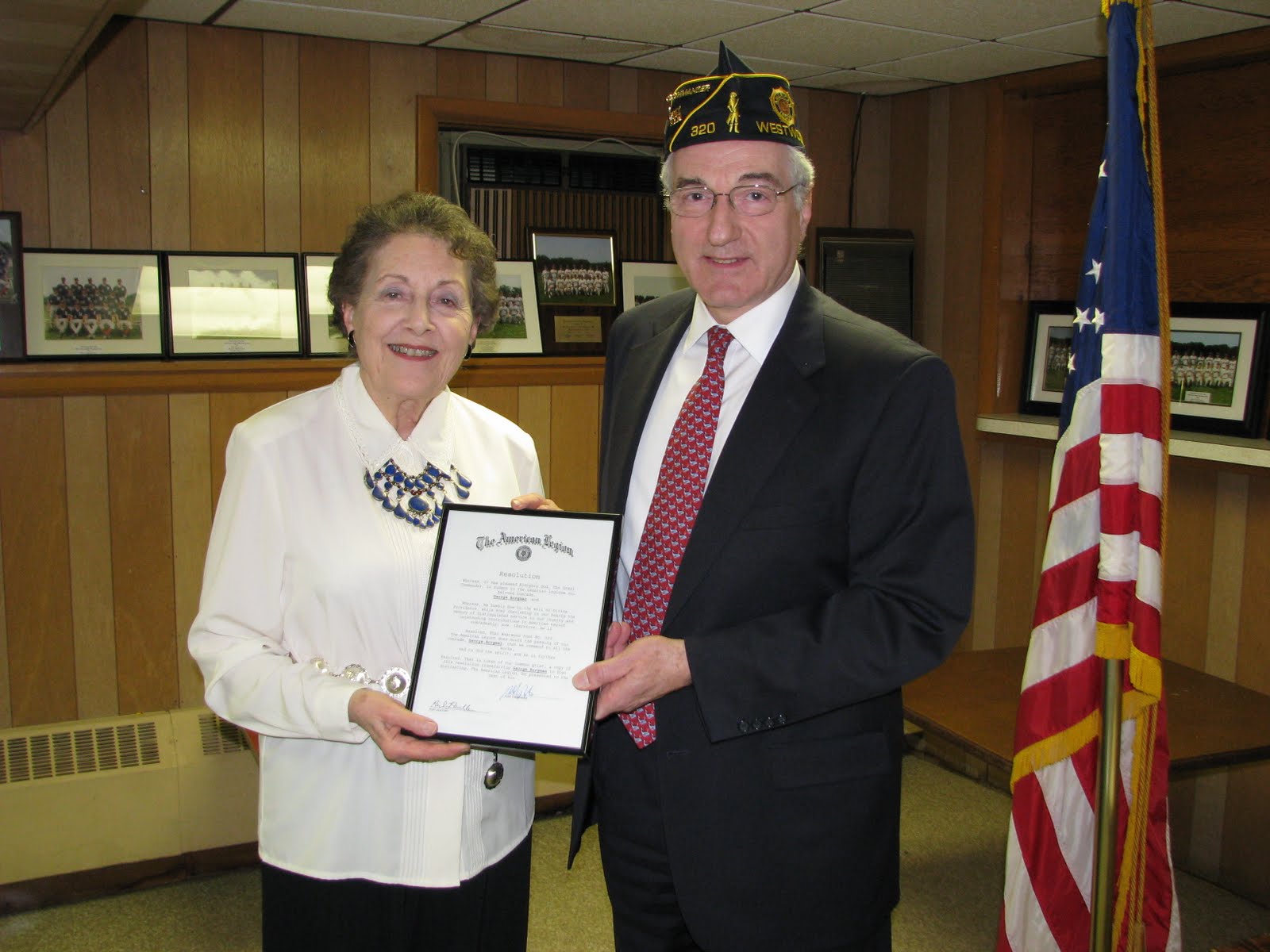
On January 4, 2010 Westwood Post 320 of The American Legion presented a framed Resolution to George's widow Janet C. Borgman in honor of George.

The Resolution stated thus:

"Whereas, It has pleased Almighty God, The Great Commander, to summon to the immortal legions our beloved comrade, George Borgman, and Whereas, We humbly bow to the will of Divine Providence, while ever cherishing in our hearts the memory of distinguished service to our country and outstanding contributions to American Legion comradship; now, therefore, be it Resolved, That Westwood Post No. 320, The American Legion does mourn the passing of our comrade, George Borgman, that we commend to all the works, and to God the spirit; and be it further Resolved, That in token of our common grief, a copy of this resolution transferring George Borgman to Post Everlasting, The American Legion, be presented to the next of kin."

Dick Paster (pictured above), after a nice meal, gave Janet the framed Resolution.

Tuesday, December 22, 2009

Performance Dedication

Craig Ball whose White Heat Swing Orchestra was named "Boston's Best Dance Band" by Boston Magazine was a longtime friend of George and would often discuss music by telephone over the years. George covered Ball's performances in The Mississippi Rag for years and had great respect for him as a clarinet player and person.

Upon hearing the news of George's death, Ball, on November 3, 2009 playing with his smaller band at the Sherborn Inn in Sherborn, Massachusetts dedicated the nights performance to George Borgman.

Ball's orchestra recorded the soundtrack for the movie Dick Tracy and has played backup for Tony Bennett and Nora Jones who used to sing with the band.

Here is Craig Ball's White Heat Swing Quintet from February 23, 2008.

Friday, November 6, 2009

Ray Smith Comments

"I knew (George) for many years, both here and at festivals around the country. I looked forward to his Yankee Jazz Column each month in the Missississippi Rag... particularly, after I moved down here to South Carolina 12 years ago.

His knack for research was equal to his descriptive skill as a writer....
always enjoyed his featured articles.

I hadn't heard this sad news, my condolences to the family. George will be remembered - long and well." - Ray Smith

Smith is the host of the WGBH radio program Jazz Decades and is a jazz drummer who was the leader of The Paramount Jazz Band.

UPDATE: Ray Smith passed away on February 26, 2010. Read the WGBH tribute.

Thursday, November 5, 2009

"Sorry to hear the news."

We were sorry to hear the news. George came down to The Larchwood in R.I. a few times to listen to us (The Jazz Strollers incl. Pete Salemi, pushing 100 years, Jeff Hughes and me). I talked with him many times on the phone. I like to think that I tossed some of my knowledge his way for his article on the Casa Loma Orch.

We enjoyed the evening at The Sherborn Inn earlier this year when Neville Dickie entertained us. And George entertained us, too.

Sorry we coudn't get to the calling hours. I had to be with The Jazz Strollers in Narragansett, R.I. from 4 to 8. Really had a nice relationship With George over the years.

Don And Diana McLean, October 31, 2009, Legacy.com Website

Praise from his Grandson

“Gramps” as I so lovingly called him was a major impact on my life for the past 27 years. His loving and kind heart will be missed by me and countless others who knew him. There is a special place for him in heaven and in my heart. I will never forget him and his wonderful and warming words.

To you Gramps:
Heaven and hell are two different places for a reason…. so try not to raise too much hell. Kiss mom for me.
Billy

William Schnarr, October 29th, 2009 | 10:22 pm, Folsom Funeral Home Website

Neville Dickie Remembers

My first meeting with George was when he interviewed me for the Mississippi Rag in 1998. He didn’t do anything by half, and thoroughly researched his subject.

Proof of this was an 18 page booklet he wrote for one of my CDs. It was always a treat to see George and wife Janet on my annual visit to the Sherborn Inn, both loving the music (and the food). Earlier this year he told me he wasn’t in good health but he was determined he and Janet would be at the Sherborn in August to see my performance with Stan McDonald - that was the last time I saw him.

George loved the dry English sense of humour and he laughed at many of the stories I told him. It was a privilege to know this wonderful man.

Neville Dickie, Carshalton Beeches, Surrey, England. October 29th, 2009 5:51 pm, Folsom Funeral Home Website

A Tribute from Stan McDonald

George was deeply devoted to the original American jazz that he loved and studied assiduously. Including others, he generously covered my Blue Horizon Jazz Band in person at the Sherborn Inn and prior venues, including the Sticky Wicket in Hopkinton (where we first met) for many years: in liner notes of our recordings, and in an extended biography of my own musical history in the February, 2003 issue of The Mississippi Rag, the premier publication preserving our heritage. I shall never forget and will always be grateful to George and his devoted wife Janet and son, Eric for their appreciation and encouragement through the best and worst of times. My wife, Ellen, and my son, Andy, are with me in sending our heartfelt condolences to them and to all of George’s extended family. May God bless and rest in peace the soul of this wonderful and dear personal friend — as his spirit lives on among us!

Stan McDonald. 25 Farm Road. Sherborn, Mass., October 29th, 2009 | 12:54 am, Folsom Funeral Home Website

George A. Borgman Death Notice


BORGMAN, George Allan Of Westwood, Oct 26. Beloved husband of Janet Claire (Ferroli) and dear father of Paul Allan, and his wife Cynthia C. Borgman of Woodstock, CT, Eric Bruno Borgman of Westwood, the late Carole Elaine Borgman and the late Andrea Vivien Hancock. Loving grandfather of Rebecca, Robert and William Schnarr. Also survived by 5 great grandchildren. Relatives and friends are invited to attend his Funeral Friday at 9 am from the Folsom Funeral Home, 649 High St., Westwood followed by his Mass of Christian Burial in St. Margaret Mary Church, 845 High St., Westwood at 10 o'clock. Interment in Blue Hill Cemetery, Braintree. Visiting hours Thursday 4-8PM. For directions and guestbook please visit our website. Folsom Funeral Home www.folsomfuneral.com

Wednesday, November 4, 2009

A Short George A. Borgman Biography


George Allan Borgman was a well known musicologist, jazz journalist, and contributing editor and columnist for The Mississippi Rag and other jazz magazines.

George earned a Bachelor of Music degree from St. Louis Institute of Music, and received a Master's degree in musicology from Indiana University, Bloomington. George played clarinet and saxophone with a few touring Midwestern bands in 1946 including Larry Tice's and Jack Everett's Orchestras.

He then joined the army at the end of 1946 and served as part of the Army of Occupation in Germany where he also played in the Army band in Heidelberg. Upon his release from the service he began touring again as a musician joining up with Jack Staulcup's Orchestra in 1950 with whom he also recorded several sides.

George became a high school band teacher and chorus director in Colorado in 1953 and in 1955 was working in Lovelock, Nevada, where he met his future wife Janet Claire Ferroli, from Boston, who was also a teacher. They were married on February 27, 1957 and moved to New York.

He began taking classes in television production at the School of Radio Technique, and subsequently began working as a lighting assistant on the Drew Pearson and Quentin Reynolds television documentaries. He quickly moved into film editing. By 1958, he was a film editor and cameraman at the NBC affiliate in Columbia, Missouri KOMU.

In September 1958, George decided to go back into the army entering the Counter Intelligence Corps and began taking classes at the Intelligence School, at Fort Holabird, Maryland. He was assigned to a CIC unit in West Berlin where he worked mostly in civilian clothes. George spent a year in the Republic of Vietnam and retired with the rank of Chief Warrant Officer 3 in 1979. In the early 1980s, he worked five years as a personnel security specialist for the Department of the Military in Alexandria, Virginia from 1981 to 1984.

He began freelancing as a sportswriter for a group of local newspapers in the Boston area. He continued covering sporting events for six years and in 1988, began writing stories for jazz periodicals concentrating mostly on ragtime and traditional jazz. He did also write about big bands, bebop, swing and modern jazz.

George wrote hundreds of reviews, articles and columns for such periodicals as the IAJRC Journal, Cadence Magazine, Joslin's Jazz Journal, TJ Today as well as The Mississippi Rag, for which he was a contributing editor and wrote a monthly column, "Yankee Jazz Beat" from 1992 up until the newspaper closed down in 2009 upon the death of its founder Leslie Johnson.

He was well known within the jazz community for his many reviews, in-depth articles on the history of jazz and on various jazz musicians as well as his monthly column. George wrote liner notes for several jazz artists and bands including the Back Bay Ramblers, Stan McDonald and His Blue Horizon Jazz Band and British boogie-woogie pianist Neville Dickie.

He wrote articles covering the annual Hot Steamed Jazz Festival in Connecticut, and on Tommy Benford, Ruby Braff, Al Casey, Buzzy Drootin, Chuck Folds, Stan Kenton, Joseph Lamb, Marie Marcus, and Stan McDonald as well as scores of others. He was voted in the top 12 of jazz critics in a 1990s poll by JazzBeat Magazine.

George was working on a book about the Casa Loma Orchestra when he died after a short illness. At the end of his funeral Mass on October 30, 2009 several famous jazz musicians performed a traditional jazz send off. John Clark and Stan McDonald played clarinet, Jeff Hughes was on trumpet and Ross Petot played the piano.