Monday, August 11, 2014

NEGRO MUSIC OF THE PRESENT - A 1918 Article by R. Nathaniel Dett


Samuel C. Armstrong
 The below article was published in The Southern Workman a publication of the Hampton Normal and Agricultural Institute of Virginia. The magazine was founded by General Samuel C. Armstrong, an educator, in 1872.

He had founded the Institute in 1868 for the education of blacks and Indians. Booker T. Washington had been a student at the school.
 
R. Nathaniel Dett
R. Nathaniel Dett, the author of the article was the Director of Music at Hampton Institute. The article was actually a chapter in a pamphlet on black American music. The article here appears as written and published in 1918.
 
Here is a link to an article regarding the history of the Hampton Normal & Agricultural Institute.
 
 
NEGRO MUSIC OF THE PRESENT
 
On page seventy-two of his “American Masters of Painting,” Mr. Charles H. Caffin makes the following statement: “ So far as could be judged from the showing made by American painters at previous expositions, they were but reflecting the influences of Paris, or of German and English painting.” And then he asks this pertinent question, “Was there, in fact, as distinguished from art in America, any American art?”
 
Turning to the realm of music, one finds an analogous situation; for, until very recently, music in America was but the reflection of music in Europe. Many of the works by American composers were even named in a foreign language, which shows how extensive was the disregard for things of native origin. If there was, in fact, any real American music as distinguished from music in America, it had as a foundation the songs of popular minstrels, including those of Stephen Foster, the ditties sung in colored operas, and the farcical “coon songs” of the vaudeville stage—music which, while being distinctive enough, was too trivial in intent and effect to constitute anything worthy of the name of “art.”
 
As for Negro composers, since it seemed the style to avoid in serious efforts any modes of expression by which one’s work might be recognized and consequently condemned as “homemade,” they, too, turned to far-away things for inspiration, becoming either second-hand imitators of Europe through their white American brothers, or, if possessing ideals, sacrificing them for mercenary ends in the creation of a form of popular music designed to satisfy a preconceived (and not very high) ideal held by white people of what Negro music should be.
 
It remained for an outsider, a Bohemian—the famous Dvorak to show America and the world something of what is possible in the larger forms of musical composition by using the Negro and Indian folk tunes, if not as actual themes, at least by allowing the spirit of them to be the acknowledged source of inspiration. So much has been written and said of the “New World Symphony," that more is not necessary here. It is sufficient to recall the fact that the symphony and Dvorak’s remark that “the future music of this country must be founded upon what are called Negro melodies” were innovations of a rather startling nature to Americans—forerunners of a new trend of thought, whose truly prophetic significance the present-day work of American composers, especially that of the Negro composers themselves, is evidencing.
 
Yet one sometimes hears in Negro concert choruses and in the playing of “rags,” jass music, and other dance tunes by untutored or only partially educated Negro orchestras and pianists, effects which surpass in real characterization any of the results obtained by Dvorak. Beautiful and unusual as the “New World Symphony" is, it yet leaves a great deal to be said through the medium of Negro folk idiom,the true expression of which will undoubtedly best be made when some Negro composer, who is thoroughly alive to and appreciative of the traditions of his race, “rises up to say some glorious thing” in the musical language of his fathers.
 
I do not mean by this that the Negro musician and composer has not been hard at work to elevate and develop his music and thus create a new and indigenous art in this country, for such a statement would be far from true. The foreign scholarship which enabled a few young Negro musicians to go abroad for further study was raised and maintained by a colored woman, who has since given festivals of Negro primitive and developed music in many of our leading cities, to the great edification of both races and of especial encouragement to aspiring black artists. One of the beneficiaries of this scholarship has made arrangements of several of the old spirituals which have gained considerable public favor as new compositions; an article from his pen on the music of his race appeared in one of the leading music journals of the country, and recently one of our largest publishing houses issued a composition for the pipe organ on a folksong theme by the same contributor.
 
Another foreign scholarship beneficiary, besides touring as solo violinist, has recently published violin arrangements of a high degree of merit based on Negro spirituals.
 
Again, a Negro musician, the protegé of Northern white philanthrophy, is now one of the best known of American singers and classic song writers. While his efforts in Negro music are small as compared with his general work, yet one short choral arrangement of an old Negro theme has become one of the most widely used pieces of American religious music.
 
Still another Negro composer has been called the Mourssorgsky of his race, because of his unusual ability faithfully to portray Negro characteristics, especially those which savor of old-fashioned superstitions and quaint humor.
 
In the West two Negro brothers have made collections of, folksongs and have used them as elements in cantatas; in the East two other Negro brothers, one of whom is a famous American litterateur, have cooperated in the production of lyric and operatic Negro music which has no equal elsewhere, and the influence of which has been largely instrumental in the rise of a new school of popular music in America.
 
Several other Negro musicians were, until the recent draft of men for the World War, leaders of characteristic orchestras especially devoted to Negro dance music—orchestras whose services were sought by leading actors and play houses in the largest metropolitan cities.
 
Another Negro composer has written two suites for the pianoforte of five numbers each, on ideas incidental to Negro life; these suites have been considerably used in conservatories and music schools. At the memorial service held at Hamilton, Ontario, last year, for the Canadian dead of the Great War, the Pièce de résistance of the program was an anthem based on a Negro spiritual by this same composer. Another of his folksong anthems has been used by practically all of the leading universities and community choirs of the country, and was one of the features of the Norfolk, Connecticut, music festival last fall. The dedication of one of this composer’s piano suites expresses something of his feeling of appreciation for the efforts of those to whom he is very largely indebted for his musical education.
 
Lastly, there has been established at the National Capital a conservatory of music, dedicated to the furtherance of Negro music; it is entirely officered by colored people and a colored woman is its principal. It has as trustees some of the leading white musicians of the country.
 
As the scope of this paper is limited to America, the work of Negro composers overseas is not mentioned. Suffice it to say that two English Negro composers have attained a most enviable position among the world’s music masters, largely by reason of their activity in the development of their own racial idiom.
 
This glimpse of the work of Negro musicians of the present day in handling their own folk tunes shows that they are at last awaking to the fact that there is a great truth in the words from Holy Writ, “The kingdom of heaven lies within.” It also shows that appreciation, often beyond what has been hoped for, is ever attendant upon worthy effort. Why even more has not been accomplished by Negro musicians in the development of their own music will appear from a study of the following facts :—

1 General indifference, amounting almost to contempt for things of native origin, and a slavish admiration on the part of American composers, critics, and, to some extent, publishers, for European ideals in music and art

2 Lack of literary masterpieces of Negro themes, which as librettos or programs would be sources of inspiration for great idiomatic musical works

3 Lack of proper musical and academic training among Negro composers

4 Lack of time for racial study and composition on the part of Negro composers
Only a moment is necessary for the discussion of these four impediments.
 
Regarding the first I quote from a treatise on music history for students by a professor in one of our leading American colleges, a college whose conservatory department ranks second to none, and which ought therefore to lead one to expect an extremely progressive point of view: “From a world-historic point of view, it cannot be maintained that American composition has advanced the development of the art, enlarged its field of expression, or propounded new problems. . . . There is no native music; there are no national traditions on which to build.”
 
And also from a society of American intellectuals devoted to the dissemination of educational literature comes the following: “From this standpoint one is inclined to contend that neither the Negro melodies nor the Indian melodies, which seem to have most impressed Dvorak in his musical researches in this country and which have been cited as the possible basis of a national school of music, have any significance whatever, or in any degree reflect national feelings or characteristics.”
 
While it must be admitted as true that American composition so far has not materially advanced the art of music, the reason is not because there is nothing indigenous on which to build, but because the great store of native assets which might be so used has been ignored by American musical architects. Furthermore, if Dvorak, Busoni, Coleridge-Taylor, and Laparra, all foreigners, could discover in America, after only a few months’ sojourn, enough native material for a symphony, a piano concerto, an oratorio, a great quantity of salon music, and an opera, it is rather safe to conclude that if American composers themselves have not found here at home inspiration for similar works. defective eyesight rather than the lack of well-springs from which to draw must be to blame. And further, if the Indian and Negro songs do not of themselves express national feelings and characteristics, it still remains true that the race question in America is a national issue, having national interests and national effects.
 
The second point needs no discussion, not even the great Dunbar having left anything which might serve this purpose. The significance of the third becomes apparent when it is remembered that, so far as the writer has been able to find out, the schooling of no Negro musician has resulted in any higher degree than that of Bachelor of Music. The foundation for the fourth item is the fact that, omitting one instance which is very exceptional, even in the case of those Negroes who seem to have attained the greatest success, composition is a “side issue," done between classes in school or after hours of work in some other profession or trade by means of which a real living can be made.
 
In the development and conservation of her physical resources, America has spent millions of Government money, but almost all that has been done towards the establishing of a national American school of art or music has been through the personal efforts of students and philanthropists. Recently an Indian boy who has no money came to me after one of my sight-singing classes and asked for lessons in harmony. He knows that the study of harmony forms no part of our school course; he came because he has caught the spirit of race and wishes to learn to express properly the music of his people. I sincerely trust that off-hours will find us working together.
 
Among the large number of Hampton students there are always some who, being endowed with pronounced natural ability, would make excellent musicians and could be trained to become strong factors in the preservation and development of race idioms. Many have earnestly expressed themselves as being ambitious in this direction but are held back by lack of funds or other circumstances which they cannot control. Such conditions among students are probably to be found in all Negro and Indian schools.
 
Could a national American philanthropy serve a worthier purpose than the special education to the highest possible point of these native-born Americans, to the end that folk traditions, which are rapidly passing away, may be saved by those who know them best, that the backward races in this country may be greatly encouraged through the attainments of their individual members, and that through a great national enterprise, true servants may be created to the great cause of a real American art?


Sunday, August 10, 2014

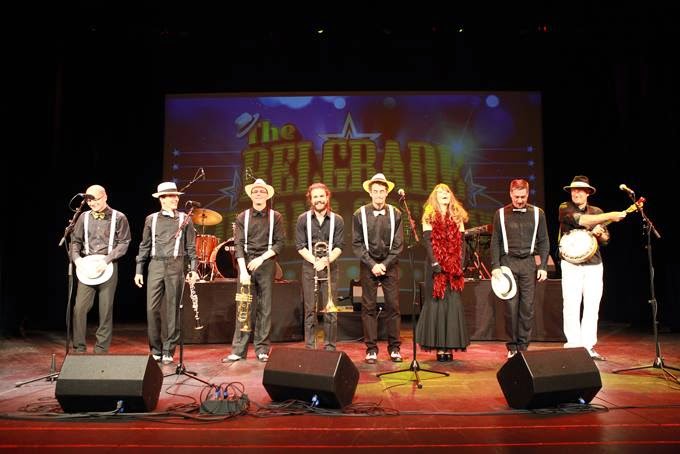
Jazz Performance Saturday! - Belgrade Dixieland Orchestra - "At the Jazz Band Ball"

This Saturday we have a video of the Belgrade Dixieland Orchestra playing At the Jazz Band Ball.
A publicity still of the Belgrade Dixieland Orchestra!
At the Jazz Band Ball which is a Dixieland Jazz standard was composed by Nick LaRocca and Larry Shields, members of the Original Dixieland Jazz Band, in 1917. The ODJB recorded their first version of this tune in New York on September 3, 1917. The group would go on to record it a few more times. It is a very popular tune and most Traditional jazz bands play it.
 
The Belgrade Dixieland Orchestra operates out of Serbia. They have an extensive list of recordings that have been put out five CDs, their last being "National Treasure" from 2012, and have made appearances worldwide, but especially in Europe.
 
Members of the orchestra are,  Vladimir Rackovic - banjo, vocals; Sava Matic - trumpet; Veljko Klenkovski - clarinet; Vukasin Markovic - trombone; Aleksandar Miletic - piano; Ivan Maksimovic - bass; Milos Milosavljevic - drums; and Aleksandra Bijelic - vocals.
 
They have a website HERE and are also on FACEBOOK!


This performance was uploaded online on March 20, 2009.
 
Listen to the Original Dixieland Jazz Band's version of the tune recorded March 19, 1919.
 

Saturday, August 2, 2014

Jazz Performance Saturday - Ross Petot on Piano - "Night and Day"

As a new feature of the Saturday Jazz Performance, Yankee Jazz Beat will highlight piano players on the first Saturday of every month.

Pianist and composer Ross Petot will be the first shown in this new feature playing Night and Day with Swing Times Five at the 2012 Hot Steamed Jazz Festival in Essex, Connecticut.
 
Swing Times Five consists of leader Jeff Hughes, on cornet; Ross Petot,  piano; Lou Bocciarelli, bass; Dan Weiner on guitar, and Dave Didriksen - drums.
 
Petot is an exceptional pianist playing any style with ease. He made a name for himself as a Ragtime and Stride piano player early on. He recorded an album of his ragtime compositions called New Ragtime and Other Stuff. His compositions are popular with others, being played at festivals and recitals across the United States.
 
Here Ross plays Cole Porter's well loved 1932 Night and Day. Porter wrote the song for the Fred Astaire stage musical The Gay Divorce. Astaire's recording of Night and Day was a hit. He would sing it again on film in 1934 for the Astaire-Roger's vehicle The Gay Divorcee.


Ross Petot's CD "New Ragtime" is still for sale contact Petot at rkmpetot@yahoo.com to order a copy. 

Wednesday, July 30, 2014

Brian Carrick's Heritage Jazz Quartet - A Review by George A. Borgman

Many British jazz musicians are obsessed with the early and even the recent jazz music of New Orleans, and Brian Carrick's recording, according to Peter King's liner notes, is supposedly the music "coming from one of the many dockside bars along Decatur Street, New Orleans, or from one of the small dance halls dotted around the French Quarter in the 1940/50 era."
 
The first of the quartet's two sessions was recorded for Bill Bissonnette's Jazz Crusade label, and the second session was recorded at a jazz festival at Pontin's, "a holiday camp" at Weston-Super-Mare, England.
 
The quartet has been in existence for many years and its members come from diverse areas of England. According to King's notes, the music consists of spirituals, blues, ballads and a couple of breakdowns; however, the "spirituals" are more like hymns, and it is questionable as to whether any of the tunes are authentic ballads.
 
Carrick plays the clarinet with a very wide vibrato which on the hymn-like tunes produces a feeling of melancholy. Bassist Ken Matthews, in the style of many British bassists, plucks the strings very loudly which leads one to believe the bass' strings are made of catgut.
 
Since there are only four players, with the clarinet taking most of the solos and playing the melodic lead, drummer Male Murphy has to produce a great variety of rhythmic variations in the background to Carrick's improvisations and variations of the melodies. This keeps the music on this CD from becoming boring.
 
The best performed tunes are "St. Phillip Street Breakdown," "God Will Take Care of You," in waltz time, "Nearer My God to Thee," "High Society" and "Burgundy Street Blues." More solos from the banjo and bass, a vocal or two, and even an added cornet would aid the listener in appreciating more of this recording which is quite interesting for the listener who likes the New Orleans sound. - George A. Borgman, IAJRC Journal
 

Brian Carrick's Heritage Hall Stompers play at a festival, Exactly Like You, 2001.

The Heritage Hall Stompers Website.

Memories of a Jazz Journalist - Part Seven - "Errors"

Here is the continuation of Memories of a Jazz Journalist by George A. Borgman.

I have reviewed numerous jazz recordings for the Mississippi Rag. In one review I identified the tune "Cross Your Heart" as "Cross Your Eyes," and in another, "Big Butter and Egg Man" as "Big Brother and Egg Man." The errors got through me, my wife, Janet, an excellent proofreader, and the editors at the Rag.

Here is the tune Cross Your Heart played by Roger Wolfe Kahn and His Orchestra in 1926.
Louis Armstrong and His Hot Five with singer May Alix - Big Butter and Egg Man, recorded in 1926.

CHECK OUT PART EIGHT

"Who would believe?" - by George A. Borgman

George Borgman writes a short autobiographical blurb on January 27, 1996.
 
Who would believe that I would be a jazz journalist in the later years of my life? I was a lousy high school student, doing best in band and orchestra, playing clarinet, and writing for the Courier, the Normandy High School newspaper.
 
I played with dance bands and combos and went on to college and eventually earned a B.M. (prefer to call it B.Mus.) degree in music history and literature and a master's degree in musicology. And until now, I've never worked as a reviewer or written concerning music subjects.
 
I'm not writing about classical music but about traditional jazz. Amazing!

Friday, July 25, 2014

Jazz Performance Saturday! Dixieland French Style - "Yes Sir, That's My Baby"

George A. Borgman said, "Traditional jazz belongs to the world," and since the Saturday Jazz Performance series was started here at Yankee Jazz Beat, it appears that he was absolutely correct.
 
We've had examples from Italy, Russia, Slovakia, Germany and of course the United States. Today's, jazz performance is one by an unknown street band in Perros-Guirec, Brittany, France during a street festival sometime in 2010.
 
Although only four in number, they certainly produce a pretty lively version of, I believe, Yes Sir, That's My Baby The group, dressed as old fashioned convicts, seems to consist of a tuba, trumpet, portable  drums contraption and a banjo. Despite their funny appearance they perform a pretty convincing dose of Trad jazz!

Yes Sir, That's My Baby was written by Gus Kahn (words) and Walter Donaldson (music) in 1925, the song being introduced by Margaret Young. Later, Al Jolson would sing it in 1930.

Since the original English version, there have been other versions in various languages including Yiddish!

So, without further ado...
 

Saturday, July 19, 2014

Jazz Performance Saturday! "Down By the Riverside" - Jericho Dixieland Jazz Band

Publicity photo taken from their Facebook
page. All rights reserved. 
The Jericho Dixieland Jazz Band is based out of San Pietro a Maida, of the Calabria region of Italy! Their performance of  Down By the Riverside was recorded March 3, 2013.
 
Down By the Riverside is an American spiritual that was first published in 1918 by the Rodeheaver Company in a musical collection called "Rodeheaver's Plantation Melodies: A Collection of Modern, Popular and Old-time Negro-Songs of the Southland."
 
Although Down By the Riverside has been assumed to be a song that originally emanated from the struggle of slaves for their freedom around the Civil War, unfortunately there is no solid evidence in the written record of this.
 
The phrase "down by the riverside" is a fairly common one in slave songs. Also, the way the song was written is similar to other call out songs where one will lead the song and others will repeat. The song has long been included in Baptist hymnals and it has been published under various titles such as, Ain't Gonna Study War No More, Goin' to Lay down My Burden, and Ain't Gonna Grieve My Lord No More among others.
 
It was first recorded by the Fisk Jubilee Quartet as I Ain't Goin' to Study War No More. It has long been played by Traditional jazz bands. Both Bunk Johnson and George Lewis during the traditional jazz resurgence  both recorded the tune as well as many many others.
 
Here the Jubilee Dixieland Jazz Band play a spirited version of the tune in the "traditional" or Dixieland jazz vein. This band was started in 2005 featuring Lorenzo Varano on trombone; Nicholas Marinaro on trumpet;  Anthony Davoli on bass tuba; Francis Davoli on euphonium;  Gianluca Materazzo on banjo and Joseph Maggisano on vocals and guitar. New members of the band are Francesco Gemelli on alto saxophone; Thomas Maggisano on drums; Luke Roseto on soprano saxophone and Andrea Bonaccurso on banjo.
 
It is not clear which members are playing in this 2013 performance unfortunately. The original video had some serious shake going on so I have processed it to make it more presentable.   


Tuesday, July 15, 2014

Thatcher/Blount/Vickers - River Stay' Way CD Review by George A. Borgman

 
Thatcher/Blount/Vickers - River Stay' Way - It is amazing how jazz has spread throughout the world and the Brits are now some of the better performers of the New Orleans style. On this recording Jazz Crusade producer Big Bill Bissonnette has come up with some very fine British musicians who play in a style reminiscent of that heard years ago in New Orleans.
 
These jazzmen are from three bands: the Ken Colyer Trust, directed by trumpeter Norman Thatcher, banjoist Dave Brennan's Jubilee Jazz Band, and clarinetist Chris Blount's New Orleans Jazz Band. Trombonist Dave Vickers is a member of the Ken Colyer Trust, and he, bassist Mick Kennedy and pianist Barry Grurnmett play in the Jubilee Jazz Band. Drummer Male Murphy works with several bands.

Put these guys together and, as Bissonnette says in the album notes, it's "a real good ensemble band." The front line musicians work very well together with fine backup from the piano, and the rhythm section provides a steady beat that is evident today in only such New Orleans-inspired bands as the New Black Eagle Jazz Band in the United States and Kid Bastien's Happy Pals in Toronto, Canada.
 
These British musicians play with feeling and dynamics while playing in New Orleans ensemble, which is immediately evident in the initial rendition, "There's Yes! Yes! in Your Eyes," from 1924. This tune was recorded by Paul Whiteman on the Victor label, Al Kahn (Columbia), Guy Lombardo (Decca), Artie Shaw (Columbia), and Eddy Howard (Mercury). And here, as elsewhere on this CD.
 
Thatcher's trumpet sounds off very well on the melodic lead and the three members of the front line and the piano have outstanding solos. Blount's clarinet, Vickers's trombone and Thatcher are at their best on solos and leads on "River Stay 'Way from My Door."
 
The ensemble playing is particularly outstanding on the traditional "Lily of the Valley," Joe "King" Oliver's wonderfully bluesy "Snag It," one of the better renditions, and "Daddy's Little Girl."
 
"Just a Gigolo," from 1930, a Viennese popular song originally titled "Schöner Gigolo," was introduced in the United States by Irene Bordoni. Its first successful recording was by Vincent Lopez and His Orchestra on the Hit of the Week label; a new recording, on a flexible disc, was issued and sold under this label's name each week at newsstands. Other early recordings were by Bing Crosby (Victor) and Harry Richman (Brunswick). Today, at concerts and jazz festivals, Berlin born Marty Grosz does a splendid vocal of this song in English and German, but here there is no vocal, unfortunately; however, the tune is one of the better offerings by the band with fine solos from the trumpet, trombone and piano, and some nice, light press rolls from Murphy.

The band is best on the snappy "Indiana," from 1917, as there are excellent solos and counterpoint from the front line, Brennan takes an interesting banjo solo, and Murphy uses the drum set, to include the snare drum, cowbells and tom-toms. Following "Indiana" is the traditional "Yes Lord I'm Crippled," a perfect selection for the final tune. For those listeners who like the wonderful New Orleans style, this fine CD is tor them. - George Borgman IAJRC Journal
 

River Stay 'Way From My Door - Barnes, England 27 December 1995.

Saturday, July 12, 2014

Jazz Performance Saturday! "Bei Mir Bistu Shein" - By a Russian Dixieland Band!

Here is an unusual performance which I was unable to learn very much about. All I could find out is that this is a Russian jazz band playing Bei Mir Bistu Shein at an unknown jazz festival.

The uploader called it "Moscow Dixieland jazz." Using an automatic translator, I believe the members of the band may be, A. Loshakov I. Pankratov A. Volkov V.  Rodionov and A. Alhasyants.

If anyone has any information they can add regarding this group, please feel free to let us know.

The song being played Bei Mir Bist du Shein also known by the German title Bei Mir Bist du Schön, was written by Sholom Secunda and Jacob Jacobs in 1932 for a Yiddish musical comedy I Would if I Could.

But it wasn't until Sammy Cahn and Saul Chaplin rewrote the lyrics in English in 1937 that the song took off, with the Andrew Sisters recording it that November. The tunes popularity made it's way around the world!


Dixieland Russian style!

Saturday, July 5, 2014

Jazz Performance Saturday - Traditional Dixie Stompers - "Back Home Again in Indiana" & "Bourbon Street Parade"

Jazz Performance Saturday is back!
 
Today we have a video of a band called the Traditional Dixie Stompers from of all places, if I am not mistaken Slovakia! I can't tell you too much about the group because everything written about them is in Slovakian.
 
In this video the Traditional Dixie Stompers are comprised of six people who play keyboards, a trumpet, saxophone, trombone, guitarist, drummer and what looks like a sousaphone.
 
The first tune played is Back Home Again in Indiana composed by Ballard MacDonald and James F. Hanley. The song was published as Indiana in 1917.
 
The next piece of music played by the band is Bourbon Street Parade which was written by the New Orleans drummer Paul Barbarin (1899-1969) in 1952 and was popularized by traditional jazz band, The Dukes of Dixieland.
 
The very last tune briefly played after the band is introduced in Slovakian is Bye Bye Blues! Bye Bye Blues was composed by Bert Lown, Chauncey Gray, Fred Hamm, and Dave Bennett in 1930. A band Bert Lown was leading recorded it for Columbia. Lown would use it as his band's theme song. It would be revived in the 50s by Les Paul and Mary Ford.
 

Traditional Dixie Stompers - August 22, 2013.

Friday, July 4, 2014

The "First" Use of Certain Instruments in Symphonies - by George A. Borgman

The object of this paper is to show how certain composers used certain instruments for the "first" time in their symphonies. First is in quotes, because scores of the first symphonies of several of the composers could not be found by this writer.

The usual orchestra of Haydn, Mozart, and Beethoven consisted of one or two flutes, two oboes, two clarinets, two bassoons, two horns, two trumpets, first and second violins, violas, cellos, and contrabasses.
 

Franz Joseph Haydn
 
Only some of the latter symphonies of Haydn are considered here. In the Surprise Symphony (94), Haydn used a triangle, cymbals, and bass drum; this was in the second and forth movements. In The Clock Symphony (101), he used two clarinets, which were usually independent of the rest of the orchestra; however, they were sometimes used with the strings, with the bassoons, and with the brass.
 
Although the Overture to Magic Flute is not a symphony, it is considered here, because not many of Mozart's symphonies are available to the writer. Mozart used three trombones (alto, tenor, and bass) in this overture. They are usually used with brass and woodwinds in harmony parts.
 
All of Beethoven's symphonies were available to the writer.
Ludwig van Beethoven
In the Erioca (3), Beethoven used three horns for the first time. Sometimes Beethoven only uses two horns, and other times he uses only one horn in this symphony. The three horns are usually used with the brass and woodwinds. 
In Symphony No. 5, Beethoven, in the fourth movement, uses a piccolo for the first time in a symphony. The piccolo usually plays in thirds or sixths with the flutes, and sometimes in unison. One contrabassoon is used, and it usually runs along with the contrabass part. Beethoven also used three trombones in this symphony; they are used separately from the rest of the brass and they are often used in choir with other brass; they also have sustaining parts.
 
In Symphony No. 9, Beethoven used four horns for the first time. They are used for sustaining, and are employed with the woodwinds and brass; all four are usually not used at one time. In the fourth movement, Beethoven uses a chorus with soprano, alto, tenor, and bass soloists, triangle, cymbals, and bass drum are also employed in this movement.
 
Three trombones are used along with the other brass in Schubert's Great Symphony (7). Schumann also used three trombones, as well as four horns (three trombones in Symphony No. 2 and four horns in Symphony No. 3).
Hector Berlioz
Berlioz uses two cornets in the Symphonie Fantastique. They are usually independent of the trumpets, but sometimes they are a part of the brass choir. In the second movement, two harps are employed to play arpeggios, chords, and scale passages. In the third movement, Berlioz introduces the English horn to the symphony; it is independent of the rest of the woodwinds, and it is usually a solo instrument in this movement. In the same movement, four timpani are used. In the fourth movement, he employs two tubas, four timpani, and a tambourine. In the fifth movement, he used six pianos, two bells, divisi first and second violins and violas.
 
In Harold en Italie, Berlioz has a viola solo part. A contrabassoon is used by Brahms in his Symphony No. 1. It is used with the timpani, basses, and cellos. In Symphony No. 2, he uses a bass tuba with three trombones.
 
Tschaikowsky also uses the tuba with three trombones in Symphony No. 2. He uses the tamtam in the fourth movement. In No. 6, he divides the first and second violins and the cellos. 
In Antar (2), Rimsky-Korsakov uses three flutes, one oboe, and an English horn together (in first movement). In the second movement, he uses a tamtam. In Scheherazade, there are triangle trills.
 
As a summary, it may be noted that the size of the orchestra increased as time passed. Berlioz seems to have set the size for the Romanticists, but not all of them followed the French composer. In the classic era, Beethoven seems to have varied the size of the orchestra more than Haydn or Mozart.
  

Haydn's The Clock Symphony (101)

Tuesday, July 1, 2014

"Waiting For the Robert E. Lee"


In 1912 a song was published that would cement a link between a 19th Century riverboat and Traditional Jazz. That song was Waiting For the Robert E. Lee by Lewis F. Muir and L. Wolfe Gilbert. It has been used to evoke a nostalgia for the Southern riverboat era on the Mississippi River and has been an exciting example of Dixieland music at it's finest.


Waiting For the Robert E. Lee was used in the first feature "All-Talking" musical film The Jazz Singer, starring Al Jolson.


The Robert E. Lee was a real riverboat that was built in 1866 and would reach the height of it's fame by taking part in a riverboat race with the Natchez that lasted from June 30 to July 4, 1870.

This is all the more interesting to the Yankee Jazz Beat because George A. Borgman's great grandfather Frank Wecker actually worked on this famous riverboat.

Frank Wecker
Frank was described as, "One of the best known local citizens of Owensboro, especially to those who have lived for years in the city." The March 26, 1905 article from the Owensboro Messenger continues. "He is, withall, a modest man, but deserves the distinction given above because of the many years he has lived here and varied experiences through which he has gone. It is probable that he can be said to have done more traveling than any other citizen in Owensboro."

Frank, "left Owensboro when a boy as a deck-sweep on a steamboat, but it was not long until he was assisting in the kitchen and later became an expert cook. It was as such that he spent many years on the great boats on the Ohio and Mississippi rivers." He saw, "the rivers of the central United States and every part of the Gulf of Mexico." As well as visiting, "the great military encampments held and spent a number of months in British Honduras."

Frank had an extreme love of music and served as a "drummer boy," from Kentucky during the Civil War. After the war he, "began his career in steamboating. He spent thirty years almost continually on boats. Much of this time was on the packet line between Henderson and Louisville, but much of the greater part of it was on the Mississippi and Southern rivers. He ran on the old Robert E. Lee with Captain J. W. Cannon. Many were the experiences he had during these steamboat days and it would take many columns in which to recite them."


The Robert E. Lee.
Captain John W. Cannon and Thomas P. Leathers the captain of the Natchez had a rivalry that can only be described as dramatic. Leathers prided himself of having the fastest riverboat in the Natchez and would race other boats using every dirty trick in the book to come out ahead. He would use barrels of lard in the boiler to give his boat an extra boost and would cut off other riverboats by veering into their paths. He even had been known to shoot cannon off in the direction of the competitors steamboats. He ruled as the king of the riverboats since about 1855 with an earlier version of the Natchez.

Captain J. W. Cannon
In preparation for the race Captain Cannon would take no chances and stripped the Robert E. Lee of every non-essential piece of metal, wood and luxury. Even the chandeliers came down.

Conversely, Captain Leathers, so sure of his boat's speed, didn't bother stripping the Natchez down. He, in fact, took the passengers denied passage on the Robert E. Lee, and loaded up with cargo. He hoped to win the race and make a hefty profit too.

Starting on June 30, 1870 from New Orleans on the Mississippi River at exactly 5 O' Clock, the two riverboats started the race! Almost immediately the Robert E. Lee with it's lightened load, crew and a handful of passengers bound for Cairo, Illinois took the lead.

Captain Thomas P. Leathers 
It took the Natchez minutes just to leave the harbor giving the Robert E. Lee a four minute lead. Hundreds of people along the shore watched the historic race and cheered as the two boats paddled up river. Needless to say that thousands of dollars were wagered on this one race that would been remembered a hundred years hence.

As the Natchez passed Baton Rouge at 8:30 PM the Lee was now six minutes ahead! Captain Leathers continued to make his stops, unloading passengers and cargo as fast as possible, but the Robert E. Lee made none and continued in the lead.

Barrels of pitch were thrown into the furnace of the Natchez to give the boat extra speed as Leathers berated his crew on the one hand and gave them shots of whiskey on the other. This tactic worked to a point because the Natchez continued to trail by only six minutes when the craft passed Natchez, Mississippi.

As the Robert E. Lee passed Vicksburg a steamboat, the Frank Pargaud, pulled alongside the Lee and tied together, long enough for the Lee to be resupplied with barrels of combustibles for the remainder of the race.

By the time the Robert E. Lee passed Memphis, Tennessee the steamboat was an hour ahead of Captain Leathers! Victory was in sight for Captain Cannon. However, disaster struck when the Lee made its one and only stop at Cairo, the steamboat hit bottom which caused the whole boat to shake.

It was mayhem for the Captain and crew. Members of the crew prayed and wept and others swore as the captain gave orders to turn this way and that  to no avail. Captain Cannon an experienced hardened captain told his pilot to put the boat in reverse.

Suddenly, with groans and scraping sounds emanating from the Lee the boat ripped free from the sandbar and they were off once again, but not before losing much of their lead. For now, the Natchez was back in view and steaming towards them with a fury.


As the distance narrowed between the racing steamboats, so too did the width of the river. As the Natchez caught up they were racing side-by-side until the two riverboats, in the narrowed waterway, collided with a hard crash.

One set of opposite passengers shook hands before the two behemoths pulled loose from each other and the Robert E. Lee managed to pull ahead and cut off the Natchez.

By the night of July 3rd the race was too close to call as the boats paddled towards St. Louis as fast as they could be made to go. Then as the night wore on a mighty fog rolled in which made sight impossible.

Captain Leathers moored the Natchez to wait out the fog. Whereas Captain Cannon threw caution and sense to the wind and continued on at a much slower speed towards the finish. Going was so bad that the Lee's crew had to use fathom lines to test the depths of the river as the riverboat proceeded through the fog. Then after only about an hour, they broke through the fog and journeyed into history.

Despite the arguments that the newer boat Natchez would have won IF it didn't stop for cargo and crew and IF it hadn't moored for six hours while the fog lasted, the American public accepted Captain John W. Cannon and the Robert E. Lee the official winner, arriving at St. Louis six and a half hours before the Natchez.
Illustration of the Robert E. Lee burning on Sept 30, 1882.
From then on the Robert E. Lee was a celebrity known as the "Monarch of the Mississippi." On September 30, 1882,  only thirty miles north of New Orleans, the Lee caught fire in the middle of the night and twenty-one people perished. Thus ended the career of the Robert E. Lee which faded into history to come out the other side into legend.

Songs about the Robert E. Lee and the steamboat race would become popular jazz tunes in the years to come. Waiting For the Robert E. Lee,  The Natchez and the Robert E. Lee and Sailing on the Robert E. Lee are three examples.

The Natchez and the Robert E. Lee.
Frank Wecker survived his steamboating days. He joined the Owensboro military group known as the Monarch Rifles, as a drummer, and took part in the Centennial Celebration of the Surrender at Yorktown in the Fall of 1881 in Washington, DC.

The love for music that Frank Wecker had, was passed down to his great grandson George A. Borgman who listened to, loved, studied, played and wrote about it all of his life.

According to Frank's obituary in 1908 there was a story, "illustrative of Wecker's love of music... that occurred while he was tending bar for Theodore Washburn on Frederica Street, near the river. A brass band was in town. Possibly it was a circus band. Anyhow, Wecker followed it leaving the bar to tend itself. He did not come back the next day -- nor the next. About a year passed, when one day Wecker walked in hung his coat on the hook and faced a regular customer of the house. 'How will you have it this time, Colonel -- straight or toddy?' And he went about the performance of the duties of the position just as though he had merely stepped out for lunch."

Four years after Frank's death Lewis F. Muir composed the music for and L. Wolfe Gilbert the words for, Waiting For the Robert E. Lee. Gilbert was just starting out in the composing world, but after Al Jolson performed the song for the first time at a Sunday evening New York Winter Garden concert, Gilbert's career took off. The song would even make the top three ragtime flavored tunes in the United Kingdom in 1913.

Turk Murphy playing Waiting For the Robert E. Lee!
Collins & Harlan recorded Dec. 13, 1912.

Saturday, June 21, 2014

Saturday Jazz Performance - The Jim Cullum Jazz Band - "Swing That Music"

Today's highlighted jazz performance is a recording from the 1990 Monsalvat Jazz Festival in Melbourne, Australia. It is the Jim Cullum Jazz Band playing Louis Armstrong's tune Swing That Music!

Jim at age 18 with horn.
Jim Cullum's band was formed in 1962 with the intent to play the traditional jazz of the greats such as  King Oliver and Jellyroll Morton. The next year, 1963 they began playing on the San Antonio Riverwalk at The Landing. They played there until 2011.

Beginning in 1987 the Jim Cullum Jazz Band has been featured on The Riverwalk radio broadcasts. While performing at all these venues the Jim Cullum and the band has traveled the world playing at festivals in Australia, Europe and Russia.

Swing That Music was composed by Louis Armstrong and Horace Gerlach. It is said that the tune was named that name in order to tie in with his 1936 autobiography of the same name.

Saturday, June 14, 2014

Saturday Jazz Performance - Midlife Dixieland Jazzband - "Tiger Rag"

Here is a staged music video of the Midlife Dixieland Jazzband playing that old traditional jazz chestnut Tiger Rag.


Midlife Dixieland Jazzband performs Tiger Rag in 2010.

There is a myriad of people who claimed to have written or developed Tiger Rag. Some, like Jelly Roll Morton and the Original Dixieland Jazz Band are of legendary status. Others all almost totally unknown accept to jazz historians and real die hard fans.

The first group to copyright and record the tune was the Original Dixieland Jazz Band on August 17, 1917 for Aeolian-Vocalion Records and then again on March 25, 1918 for Victor.


Original Dixieland Jazz Band - March 25, 1918.

Some New Orleans musicians claimed that the tune was being played in New Orleans years before ODJB recorded it. Some named musician Jack Carey as the composer, others named saxophonist Achille Baquet. A Ray Lopez copyrighted a similar tune under the name Weary Weasel another person Johnny DeDroit copyrighted it as Number Two Blues.

On the Library of Congress recordings of Jelly Roll Morton that Alan Lomax made one can hear the master pianist explaining how he used the melody of an old quadrille, made some additions and developed the tune.

Whatever the actual truth is it would appear that it did develop from a French quadrille and additions added by various musicians over the years. The arrangement played and copyrighted by the Original Dixieland Jazz Band became the predominate versions in the years following their record releases.

Tiger Rag has become one of the mainstays of Dixieland jazz. The predominance of performances and recordings of Tiger Rag proves it to be one of the most played jazz standards.


Wednesday, June 4, 2014

FROM THE ARCHIVES - Ruby Braff

Ruby Braff at home. Photo by George A. Borgman in 1995.
George A. Borgman interviewed and wrote an in-depth article on trumpeter and cornetist Ruby Braff in 1995.

The article was entitled The One and Only Ruby Braff  and was published in the December 1995 Mississippi Rag newspaper.


Monday, June 2, 2014

Memories of a Jazz Journalist - Part Six - Ralph Sutton

Here is a continuation of a series of entries that come from an article that George wrote in 2004 entitled Memories of A Jazz Journalist.

One of the most amusing of the 147 "Yankee Jazz Beat" columns I have submitted to the Mississippi Rag concerned stride pianist Ralph Sutton.

The Sherborn Inn, Sherborn, Massachusetts, has a grand piano, and when I asked Ralph who made it, he said it was a Yamaha.

I quipped, "Doesn't Yamaha make motorcycles?"

And Ralph replied, "It plays like a motorcycle.

Ralph Sutton was born in Hamburg, Missouri on November 4, 1922.

Sutton grew up in Howell, Missouri and was trained in classical piano. At the age of 11 he was playing in his father's dance band and by 1936 he was playing piano around St. Louis. As a teenage he would listen to the Harlem Rhythm radio show which first introduced him to "stride" piano; the style he would play for the rest of his life.

Jack Teagarden
Jack Teagarden heard Sutton play around 1940 at a college and recruited him for his band. Sutton played with Teagarden until he was drafted into the Army in 1943.

After the conclusion of World War II, in 1945, Sutton returned to St. Louis and worked with the Joe Schirmer Trio as well as working at radio stations in the area.

Sutton then journeyed to New York rejoining Jack Teagarden's band for about about a year until becoming the intermission pianist at Eddie Condon's where he soon gained a following as he playing ragtime and stride. He garnered a regular slot on the This is Jazz radio program which furthered his notoriety.

In 1952 Sutton was asked to London to play the Royal Festival Hall. This was the start of his many European tours which would continue until his death.

Earl Hines, 1947
He and his family moved to San Francisco where he subbed for Earl "Fatha" Hines at the Hangover in the fall of 1957. He then joined Bob Scobey's dixieland band.

He was invited to play in Colorado where he met his second wife who ran the Rendevous Club. Sutton along with Milt Hinton, Gus Johnson and occasionally Ruby Braff turned the club into a jazz center. His friendship with Braff lasted 52 years and they would record together occasionally.

Ralph Sutton traveled the world and played many of the old masters tunes, such as James P. Johnson, "Fats" Waller, and Willie "The Lion" Smith. Jazz writer Scott Yanow called him, "one of the greatest stride pianists ever." 

Sutton died at the age of 79 on December 30, 2001 in Denver he was survived by his wife Sunnie and three sons from his first marriage.


Ralph Sutton plays Scott Joplin's Cascades in 1960.

Ralph Sutton plays Honeysuckle Rose in Italy on May 17, 1979.

CHECK OUT PART SEVEN

Saturday, May 31, 2014

Saturday Jazz Performance - The New Orleans Swamp Donkeys Traditional Jass Band - "Bourbon Street Parade"

This Saturday lets take a look and a listen to The New Orleans Swamp Donkeys Traditional Jass Band playing Bourbon Street Parade!

Bourbon Street Parade was written by the New Orleans drummer Paul Barbarin (1899-1969) in 1952 and was popularized by The Dukes of Dixieland.

This performance of the tune took place at the 40th Anniversary of the Sacramento Music Festival on May 24, 2013.

The band in this video consists of five members: The leader and trumpet player is James Williams, Sam Friend is on banjo, Jon "ToeJam" Ramm is on the trombone, the Sousaphone is played by Wes Anderson and lastly Josh "Jams" Marotta is on drums. Although not seen in this video their clarinet player is Joe Goldberg.

They describe what they play as being, "traditional jazz, blues, jass originals, vaudeville, modern jazz adaptations, and many other jazz and New Orleans-derived styles."

Saturday, May 24, 2014

Saturday Jazz Performance - The Dutch Swing College Band with Teddy Wilson - "Oh, Lady Be Good"

This Saturday we have a jazz performance that was recorded in 1976 in Austria. The great pianist Teddy Wilson joined The Dutch Swing College Band for this rendition of Oh, Lady Be Good.

Oh, Lady Be Good was written by George and Ira Gershwin in 1924 and debuted in the Broadway show, Lady Be Good! which starred Fred and Adele Astaire.

The band here consists of  the leader Peter Schilperoort who's on clarinet, Bert de Kort who plays the cornet, Bob Kaper is on the alto sax, Dick Kaart is playing the trombone, Jaaap van Kempen plays guitar, Henk Bosch van Drakensteyn is playing bass and Huub Janssen is on drums. Teddy Wilson is guesting on the piano.

Thirty years later, Bob Kaper would become the leader of Dutch Swing College Band.


Here is Paul Whiteman's Take on Oh, Lady Be Good from December 29, 1924.
 

Saturday, May 17, 2014

Saturday Jazz Performance - Duke Heitger's Hot Jazz Septett - "Baby Won't You Please Come Home"

As a new feature, here at the Yankee Jazz Beat blog, every Saturday a jazz performance caught on tape will be posted.

A publicity photo of Duke Heitger.
Today, we'll look at Duke Heitger's Hot Jazz Septett and their performance of  Baby Won't You Please Come Home. 

The performance took place at Duisburger Hof in Germany on May 9, 2011. The band here is comprised of Duke Heitger, the leader, and who also plays trumpet and sings, Dan Barrett on trombone, Evan Christopher who plays both the clarinet and tenor sax, Bernd Lotzky plays the piano, David Blenkhorn on guitar, Kerry Lewis playing bass, and Jeff Hamilton on the drums.
 
Baby Won't You Please Come Home was written by Charles Warfield and published by Clarence Williams in 1919.